R.S.P.C.T.
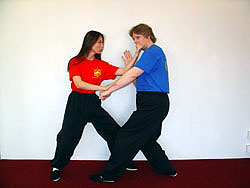
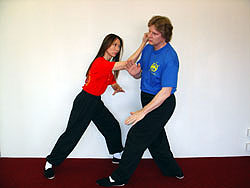
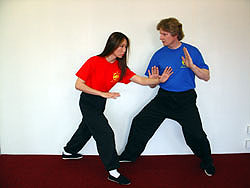
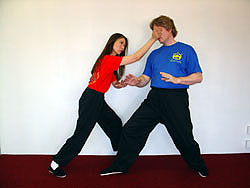
GIVING MARTIAL ARTS RSPCT
INTERVIEW CONDUCTED BY DAVE CATER
(First printed in Inside Kung Fu Magazine - July 2004)
Introduction (by: Dave Cater)
Inside Kung-Fu Hall of Fame member Mike Patterson is among the finest and most successful instructor/coaches in the world. His hsing-I-based fighters have always been admired for both their technique and toughness, especially in a sport dominated by hard stylists.
But several years ago, the San Diego, Calif., teacher discovered that it was taking many of his students too long to master the skills necessary to become proficient in fighting. And so he created Realistically Structured Progressive Combat Training (RSPCT), which essentially cuts through the static exercises and singular forms that stand in the way of skill progress. Patterson insists that many students simply give up on their training because it takes too long to reach their goal. He maintains RSPCT gives practitioners a more "direct" route to internal mastery. Here's how it works:
INTERVIEW
INSIDE KUNG-FU: What is RSPCT?
MIKE PATTERSON: RSPCT stands for Realistically Structured Progressive Combat Training. The program contains five tiers of training with each tier broken into two segments for a total of ten parts. The program is non traditional in that it does not utilize fixed singular form in training but rather a progressive series of drills and conceptual teaching to impart graduated fighting skill.
INSIDE KUNG-FU: Why is there a need for RSPCT training?
MIKE PATTERSON: Many people interested in the martial arts today do not want to spend the time necessary to become proficient in an entire system. The seemingly endless training in static exercises and singular forms turns many people off who are looking for a more direct route to skill. In creating RSPCT, I am trying to offer those individuals an opportunity to learn the core lessons of the internal martial arts in a different venue.
INSIDE KUNG-FU: Was there something lacking in your training that led to the creation of RSPCT?
MIKE PATTERSON: Quite the contrary. I feel that the internal arts are one of the few complete systems of combat out there. But the fact remains that to study the internal arts to "completion" requires many, many years. Most people today do not have the patience or see the need to spend that much time to master a complex discipline.
INSIDE KUNG-FU: With all your students' fighting success, why did you feel a need to make changes?
MIKE PATTERSON: Actually, it was because of those successes that the concept of RSPCT was born. Through the implementation of core principles found in internal martial training, we were able to successfully train exemplary fighters for competition in a relatively short time span. This in turn spawned the idea that the same approach could be used on a scale much broader than competitive fighting endeavors.
INSIDE KUNG-FU: Has the teaching of the internal styles become more of an exercise, in well, exercise?
MIKE PATTERSON: For many, yes. In my humble opinion, too many teachers have gotten away from the very ideals that caused the martial arts to come into being in the first place. Afterall, they are "martial arts" first and foremost aren't they? By what perspective some individuals seemingly ignore the first word in favor of the second I will never understand.
INSIDE KUNG-FU: If so, how did that happen, since each of the internal arts has such a strong external root?
MIKE PATTERSON: I speculate that there are many reasons. The vast majority of martial arts practitioners out there are seemingly uninterested in developing true fundamental fighting abilities these days. For many, perhaps the reality of having to one day utilize their skills to defend themselves or those they care about simply does not resonate strongly enough.
INSIDE KUNG-FU: Does your RSPCT program add to internal training or have you abandoned much of the traditional teaching?
MIKE PATTERSON: RSPCT is a distillation, a synthesis of all that I have learned in the past 33 years while practicing, competing and coaching full contact fighters in the internal disciplines. It is by no means an abandonment of traditional teaching. When you have been doing traditional martial arts for as long as I have, it gets in your blood and it becomes impossible to contemplate abandoning that which makes you breathe. RSPCT simply offers an alternate route.
INSIDE KUNG-FU: Are students not being taught the external qualities of the internal systems?
MIKE PATTERSON: In many schools I believe this to be true. To a great many practitioners out there the notion of training "internally" means something akin to "let's tune in and sense our own energy". I will be the first to admit that this is a part of the tradition of internal training but it by no means ends there. If you wish to develop the internal martial arts as complete disciplines, then you cannot ignore the conditioning side of things. A body that is not conditioned properly cannot obey the commands of the mind. Please note that I did say "conditioned properly" as I don't believe in a "buckets of sweat" approach to conditioning for its own sake. The internal martial arts are about efficiency and precision. If conditioning is approached haphazardly, you will become stronger but you will not become more efficient and you will not become more internally capable. Both sides of training must be held in balance and perspective.
INSIDE KUNG-FU: Many first-generation sifu do not like to teach the fighting aspects of their style. Why do you think that is?
MIKE PATTERSON: I cannot speak to what motivates other sifu. I can only speak to my own motivations.
INSIDE KUNG-FU: Let's break down RSPCT. How much is tai chi, how much is hsing-I, and how much is paqua?
MIKE PATTERSON: Most of the tactical and theoretical concepts are based in Hsing I and Pa Kua. The principles of Tai Chi are utilized primarily in close quarters for neutralization prior to takedown. RSPCT is divided into five broad categories of training; Reflexive, Structural, Perceptual, Conceptual and Tactical. The components of these five categories are being drawn from all three internal arts and then implemented based on relative utility.
INSIDE KUNG-FU: Are there any internal qualities in the teaching, or is the teaching strictly external?
MIKE PATTERSON: The internal qualities of power generation are brought in almost immediately. Of course the initial phases must, by necessity, focus on structure and alignment. Otherwise, attempting to teach power generation is futile at best. The more abstract qualities, such as 'intention' are infused later on.
INSIDE KUNG-FU: You have gained quite a reputation as a successful san shou/kuoshu fighting coach. How can RSPCT make your fighters even better?
MIKE PATTERSON: RSPCT is not about competitive fighting, although it would certainly prepare you for such an endeavor. The goal of RSPCT is to go beyond competitive fighting and reach into street encounters as well. A person completing the first three tiers of the program will have learned the lion's share of the information my teams learned and utilized in the competitive arena. The final two tiers are designed to mature additional skills useful for the street environment.
INSIDE KUNG-FU: Do you need a background in the internal styles to become proficient in RSPCT?
MIKE PATTERSON: No. It is designed as a "stand alone" package.
INSIDE KUNG-FU: Do you have to come from a Chinese style background, or can RSPCT be equally appreciated by a practitioner of any style?
MIKE PATTERSON: I believe the general concepts can be gleaned by practitioners of all backgrounds. The most common obstacle for many is the fluid method of power generation found in the internal arts body mechanics.
INSIDE KUNG-FU: How long will it take for the averaged martial artist to gain proficiency in the RSPCT program? In other words, is there a timetable to proficiency?
MIKE PATTERSON: In training teams for competition, I was successful in taking people with little or no background and turning them into fighting champions inside of one year. I am shooting for a similar timetable in this program regarding the first three tiers of training. I anticipate two years for completion of all five tiers of training.
A message from Shrfu Mike Patterson:
From time to time, we all have to deal with those who are trying to make a name for themselves off of building on the reputation of another. In this case, it is my reputation that is being utilized by another in a lame attempt to foster his own agenda. If interested in such nonsense, please feel free to read my side of things by accessing the link immediately below.
Formal Rebuttal to James W. McNeil

Xingyi: A Means To An End
Mastering the Combat Mechanics and Internal Power of Hsing-I Quan
In the world of internal martial arts, many get lost in the "way" and forget the "end." "Xingyi: A Means To An End" by Shrfu Mike Patterson is a definitive guide designed to strip away the mystery and focus on the core objective: functional, high-level combat application.
Whether you are a beginner or a seasoned practitioner of Neijia (Internal Kung Fu), this book provides a comprehensive roadmap for developing the explosive power (Fa Jin) and structural integrity that defines Xingyi Quan (Hsing-I).
Key Features of This Essential Xingyi Training Guide:
The "Means to an End" Philosophy: Learn to view forms and drills not as performance art, but as precise tools for developing combat efficiency and internal strength.
Biomechanical Analysis: Deep dives into the Six Harmonies (Liu He) and the structural alignment required to generate "Old School" Xingyi power.
Five Elements & 12 Animals: Practical breakdowns of the foundational Five Elements (Wu Xing) and the specialized combat characteristics of the 12 Animals, ensuring your practice translates to real-world application.
Strategic Application: Detailed insights into the fighting strategy of the Hsing I Martial Arts Institute, focusing on directness, "entering," and overwhelming an opponent's center.
Clear, High-Quality Instruction: Written with the same clarity found in Shrfu Patterson’s instructional video series, making this the perfect companion for home study or dojo training.
Who Should Read This Book?
Xingyi Quan (Hsing-I) Students looking for a structured, lineage-based curriculum.
Internal Martial Artists (Bagua and Taiji practitioners) seeking to add explosive "Hard-Internal" mechanics to their skill set.
Combat Athletes interested in the unique power-generation methods of traditional Chinese martial arts.
Stop "practicing" and start "training." Discover why Xingyi: A Means To An End is considered a cornerstone text for the modern internal martial artist.
The R.S.P.C.T. method for Xingyi and for Bagua is completely broken down and explained in both of my books.

Bagua: A Means To An End
Decoding the Combat Mechanics and Sophisticated Power of Bagua Zhang
In Bagua: A Means To An End, Shrfu Mike Patterson strips away the "flowery" misconceptions of the circular art to reveal a sophisticated, high-level system of combat. This is not a book about aesthetics; it is a technical manual for mastering the tactical superiority and internal power of Bagua Zhang (Pa Kua).
Whether you are exploring Bagua Circle Walking for health or seeking its legendary martial applications, this guide provides the "blueprint" for moving from basic forms to functional combat efficiency.
Key Features of This Essential Bagua Training Guide:
The "Means to an End" Philosophy: Learn why the complex movements of Bagua are precise tools for breaking an opponent’s structure and achieving a strategic advantage.
Core Mechanics & Footwork: In-depth analysis of Circular Footwork (Mud Stepping), the Single and Double Palm Changes, and the critical role of the Twisting/Coiling Power (Silk Reeling).
Combative Application: Discover how to transition from "The Walk" to real-world fighting, focusing on Entering, Evasion, and Continuous Attack strategies unique to the Bagua system.
Internal Energy & Body Alignment: Detailed instruction on the Eight Mother Palms and the structural integrity required to generate internal force while in constant motion.
Lineage-Based Training: Built on the proven curriculum of the Hsing I Martial Arts Institute, this book serves as the perfect text-based companion to Shrfu Patterson’s Bagua instructional video series.
Who Should Read This Book?
Bagua Zhang (Pa Kua) Students who want to understand the why behind the circle.
Xingyi and Taiji Practitioners looking to integrate sophisticated angular footwork and evasion into their internal practice.
Martial Artists interested in the biomechanics of coiling power and "soft" style combat.
Master the Art of Change. Discover how Bagua: A Means To An End transforms traditional forms into a formidable, practical fighting system.